
What is a sofra? The philosophy of the shared Turkish table
Sofra is a cloth, a sequence, and a way of feeding people together — why we built an ordering ritual around the table, not the ticket.
· Guides
Sofra is the cloth you spread on the floor or the table you lay in a dining room, and by extension the meal that happens on it. In older houses the sofra was round, low, and democratic: everyone reached the same center. You did not get “your” plate so much as you got a place at a shared geography of dishes. Even now, in a restaurant with proper chairs, the Turkish table resists the Western sequence of starter-for-you, main-for-you, dessert-for-you. Dishes arrive to the middle. Hands cross. Bread is a utensil.
There is a blessing — sofra duası — still said in many families before the first tear of bread. There is an ethics: do not start meat before guests have something cold and something to drink; do not let a neighbor’s plate look poorer than yours; do not rush people who are talking. Hospitality (misafirperverlik) is not a brand value. It is a social technology for making a stranger less strange. The Prophet’s saying that a guest is a gift from God is quoted in secular kitchens too, because it works.
Sequence is hospitality
A sofra has a weather. It opens cool: meze, salad, maybe soup. It builds heat: the mangal, the tray kebab, the güveç. It closes sweet and bitter: baklava, fruit, tea, coffee. Drinks punctuate rather than dominate — ayran with grill, çay after, rakı if the night is long and the meze is serious. If everything lands at once, you have a buffet. Buffets are efficient. They are not a sofra.
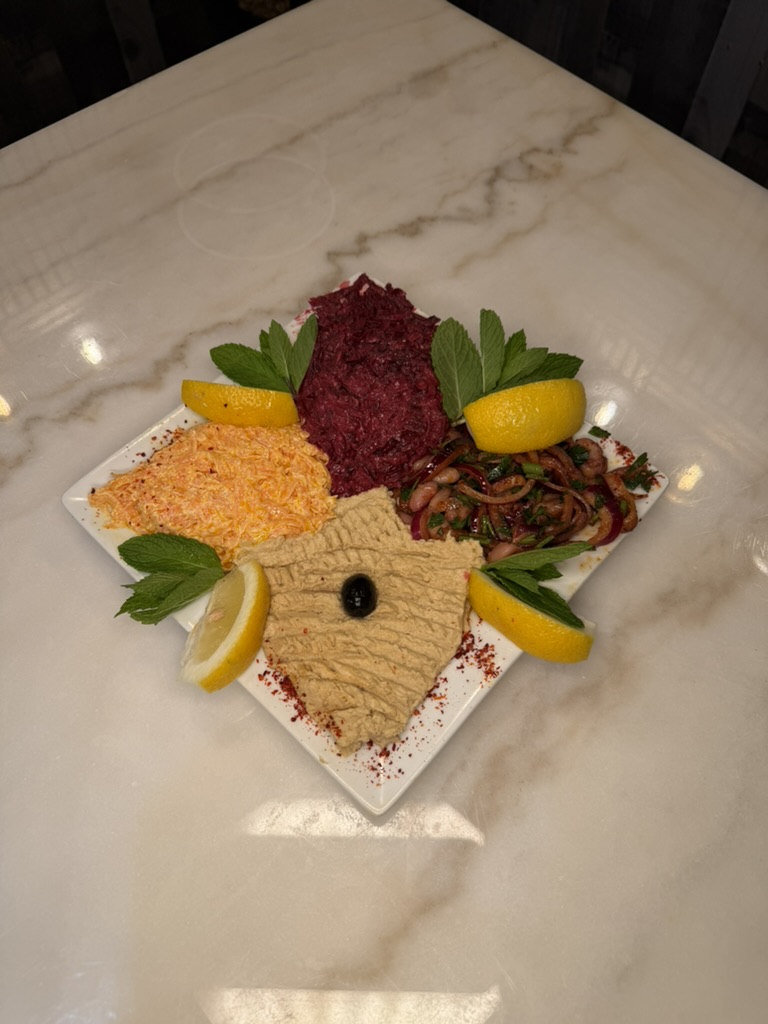
This is why “Build your table” sits at the center of our ordering, not as a gimmick but as a translation. American online ordering is a list of tickets. The kitchen receives item, item, item, with no sense that table six is four people who intended a meal together. A sofra order groups the table: meze, grill, sweet, drinks, one party size, one ticket. The cooks can fire in sequence. The baklava does not die under a heat lamp while the Adana is still raw.
A table is a meeting place, a gathering ground — the source of sustenance and fellowship.
How to sit one in Agawam
For two, think two or three meze, one grill to share or two modest ones, baklava to split, tea. For four, double the meze, put a mix grill or chops in the middle, add a home-cooking dish if the board is lit, and do not skip the sweet. For six or eight, you are in banquet territory: hummus is not optional, a second hot meze keeps the table generous, and drinks should be ordered as a round, not as afterthoughts. Our builder will nudge you if the table looks thin. That nagging is the ghost of an auntie. Listen to her.
You can of course order a single kebab and leave. We will cook it well. But if you came to understand why this cuisine lasted in palaces and villages alike, spread the cloth. Eat from the middle. Let the courses be weather, not a checklist. That is a sofra — in Cappadocia the region, and at Cappadocia on Walnut Street.
The word itself is worth sitting with. Sofra is related to the idea of traveling provision — a spread you can make anywhere there is bread and company. Anatolian households still speak of sofra as something you open and close, like a book. Opening it is an invitation. Closing it, after tea, is a blessing on the house. Online ordering usually cannot carry that. We built the sofra flow so that, at least in the kitchen ticket, the invitation is visible: these items belong to one table, fired in an order that respects the cloth.