
Ottoman palace cuisine: hünkar beğendi, alinazik, and the imperial kitchen
From the Topkapı hearths to Gaziantep: smoked eggplant, lamb, yogurt, and how palace taste still shapes a neighborhood restaurant menu.
· History
The Ottoman palace kitchen at Topkapı was not a metaphor. It was a complex of hearths that fed thousands — the sultan’s table, the harem, the janissaries, the visiting ambassadors — with a logistics that would humble a modern banquet hall. Cooks specialised. Rice had usta. Sweets had usta. The imperial cuisine absorbed Persian, Arab, Balkan, and Caucasian techniques until “Turkish food” meant, at the high end, a synthesis rather than a peasant default. What survived into restaurants like ours are not costumes. They are a handful of dishes whose architecture is still obviously courtly: smoke, lamb, a purée that took time, a name that remembers a person.
Hünkar beğendi: the sultan liked it
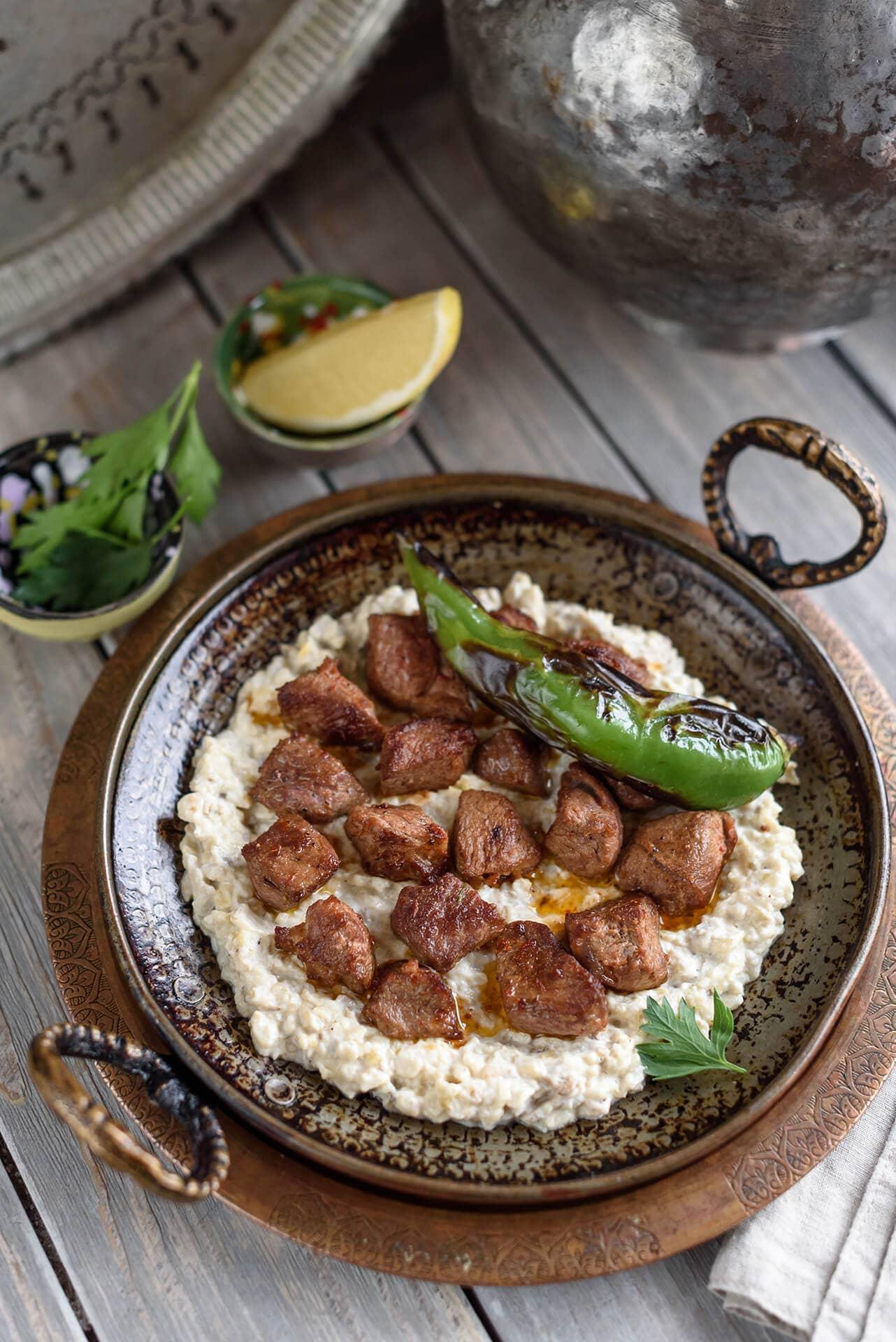
Hünkar beğendi means “the sovereign approved.” The legend is Empress Eugénie’s visit, or an earlier sultan’s nod; the dish is lamb (or sometimes beef) in a restrained sauce over beğendi — eggplant smoked black, peeled, beaten with milk and kaşar or similar cheese into a savoury custard. It is not baba ghanoush. There is no tahini. The smoke is the seasoning, the dairy is the body. If the eggplant is bitter, the cook rushed the fire or skipped the draining. If the purée is glue, someone added flour as a panic. It should sit on the plate like velvet, with the lamb as a gloss, not a pile of stew hiding mush.
Alinazik and the south
Alinazik is often described as hünkar’s Gaziantep cousin. Smoked eggplant is mashed with garlic and yogurt rather than béchamel-like cheese sauce, then topped with cubes of kebab and melted butter with pepper. It is brighter, more acidic, less “Frenchified” than some palace reconstructions. The two dishes on one menu are not redundancy. They are a map: Istanbul’s court in one bowl, Antep’s grill culture in the other. Order the one that matches the rest of your table. Alinazik loves Adana. Hünkar loves a slower lamb.
Palace cuisine also left us the idea of the tray and the stuffing: tepsi kebab, dolma, sarma, a chicken in the Topkapı style. These are dishes that require a kitchen to think in barges, not in à-la-minute sauté pans. American diners sometimes expect them to eat like a steakhouse main — a protein, a starch, a vegetable at twelve, six, and nine. Ottoman plates are stacked: the vegetable is the bed, the meat is the blanket, the butter is the weather.
A dining destination — meze, mangal, and a table meant to feel generous — because the palace and the village both deserve a proper house.
We cook these dishes in Agawam with Massachusetts lamb and eggplants that have never seen a Bosphorus market. The authenticity that matters is technique: char the eggplant until the skin is coal, so the flesh tastes of campfire, not of steamed sponge. Salt the lamb as if you mean it. Do not drown either plate in brown gravy. If you have never had hünkar, do not pair it with a cola and a hurry. It is a quiet dish. It was built for a table that already understood meze and rice. Give it that table, even here.
And if you leave still hungry for the wider imperial map — Circassian chicken, almond soups, a whole literature of pilav — come back. A neighborhood restaurant cannot be Topkapı. It can keep two palace doors open every night, and that is more than most cities bother to do.
The palace kitchen also taught portion as politics. A dish like hünkar is rich; it was never meant to be the only food on a table of twelve. It sat among pilavs, pickles, yogurt drinks, and bread. If you order it here as a lone main with nothing else, it can feel heavy. Order a salad or a cold meze beside it. The eggplant will taste more of smoke and less of duty. That is how court food survives in a room with parking out front: you still have to feed it company.