
Why we cook home-style Turkish dishes fresh each day
Güveç, karnıyarık, mantı, the morning board: why Cappadocia’s Turkish dishes are cooked as a day’s work, fresh when the board says so.
· Technique
The mangal is theatre. Home cooking is the house. In a Turkish family the weekday lunch is more likely to be kuru fasulye, a güveç, stuffed eggplant, a tray of köfte with potato, than a skewer you turned for guests. Restaurants love the skewer because it photographs. We keep a board of Turkish dishes anyway, and we light only what we are actually making that morning. If a plate is marked unavailable, it is not a website glitch. We did not cook it today. That is the whole essay, and it is worth repeating until the Valley stops asking why the stew is “out.”
Fresh each day is not a slogan we borrowed from a farm stand. These dishes die in a steam table and they lie in a freezer. Karnıyarık — eggplant split and filled — wants to be fried or roasted, stuffed, finished, served before the flesh turns to duty. Mantı wants yogurt and paprika butter that have not sat into a skin. Kuzu tandır wants time, then a plate, not a reheat that turns lamb to string. A kitchen that pretends thirteen home-style plates are always ready is a kitchen that cooked them on Monday.
The board is a morning argument
Someone in the kitchen decides, with the produce and the lamb and the hours ahead of service, which pots will exist. Thirteen names live on the menu as a literature. Four or five might be alive on a given Tuesday. That is how a house cooks. American diners are trained by all-day breakfasts and 24-item “authentic” lists that never blink. We would rather blink. Look at the Turkish dishes section. Order what is on. If your favorite is dark, come tomorrow, or call, or eat Adana like a person who can pivot.
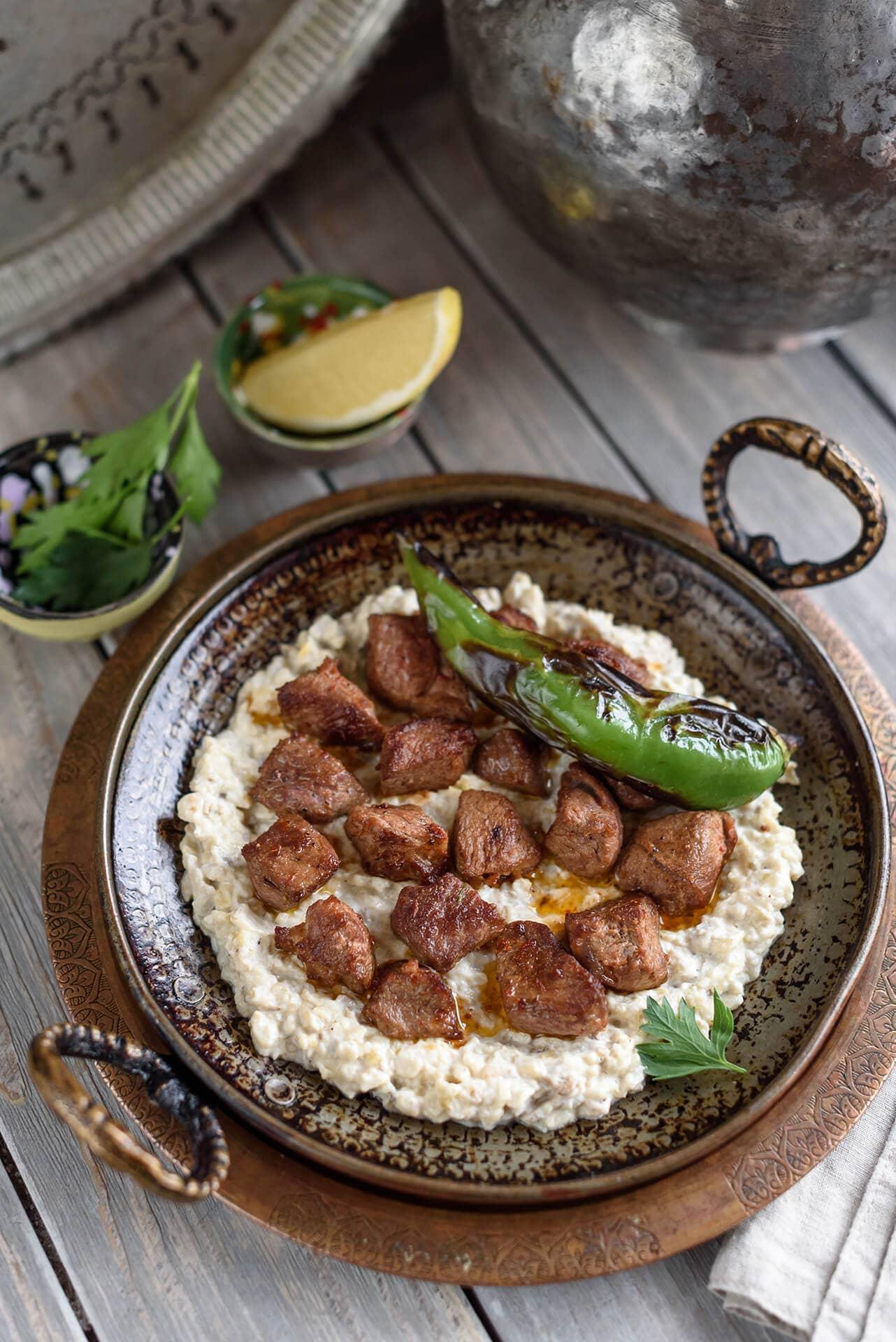
Hünkar beğendi and alinazik sit nearer the Ottoman and Antep registers: smoked eggplant, lamb, dairy as architecture. They still obey the same law of time. Eggplant must meet fire until the skin is coal. If we are not ready to do that, we will not send a beige purée and hope you close your eyes. Güveç in clay is a different patience — oven, juice, a lid. İzmir köfte is köfte that agreed to live with potato and tomato in a tray. None of these are “sides.” They are mains with a quieter voice than the mix grill.
Fresh each morning is quality control. A board unchanged for three weeks is a freezer.
Why Agawam guests should care
Because a neighborhood restaurant that only grills is still missing the pots the family eats on their own days off. Because the people who work here still eat stew when they clock out. Because Western Mass winters want a pot more than they want a skewer, even if the skewer is excellent. Because “sold out” on a home-style dish is a sign of life. Because Est. 2025 means we are young enough to refuse bad habits before they calcify.
Order home cooking with meze, not instead of a table. These plates are rich. They want salad, yogurt, bread, a pickle if we have one. They want tea after. They do not want to be the only object in front of a person who is also trying to drive to Six Flags in twenty minutes. If you are in a hurry, pickup a grill. If you have an evening, ask what the board lit. That question is how you tell the kitchen you understood the house.
We will keep cooking these dishes fresh each day until the alternative looks like honesty — and it never will. The freezer is efficient. The sofra is not trying to be efficient. It is trying to taste like someone woke up in Agawam and decided, with actual pots, what the family would eat. You are invited to that decision. Check the board. Then sit down.